Loading
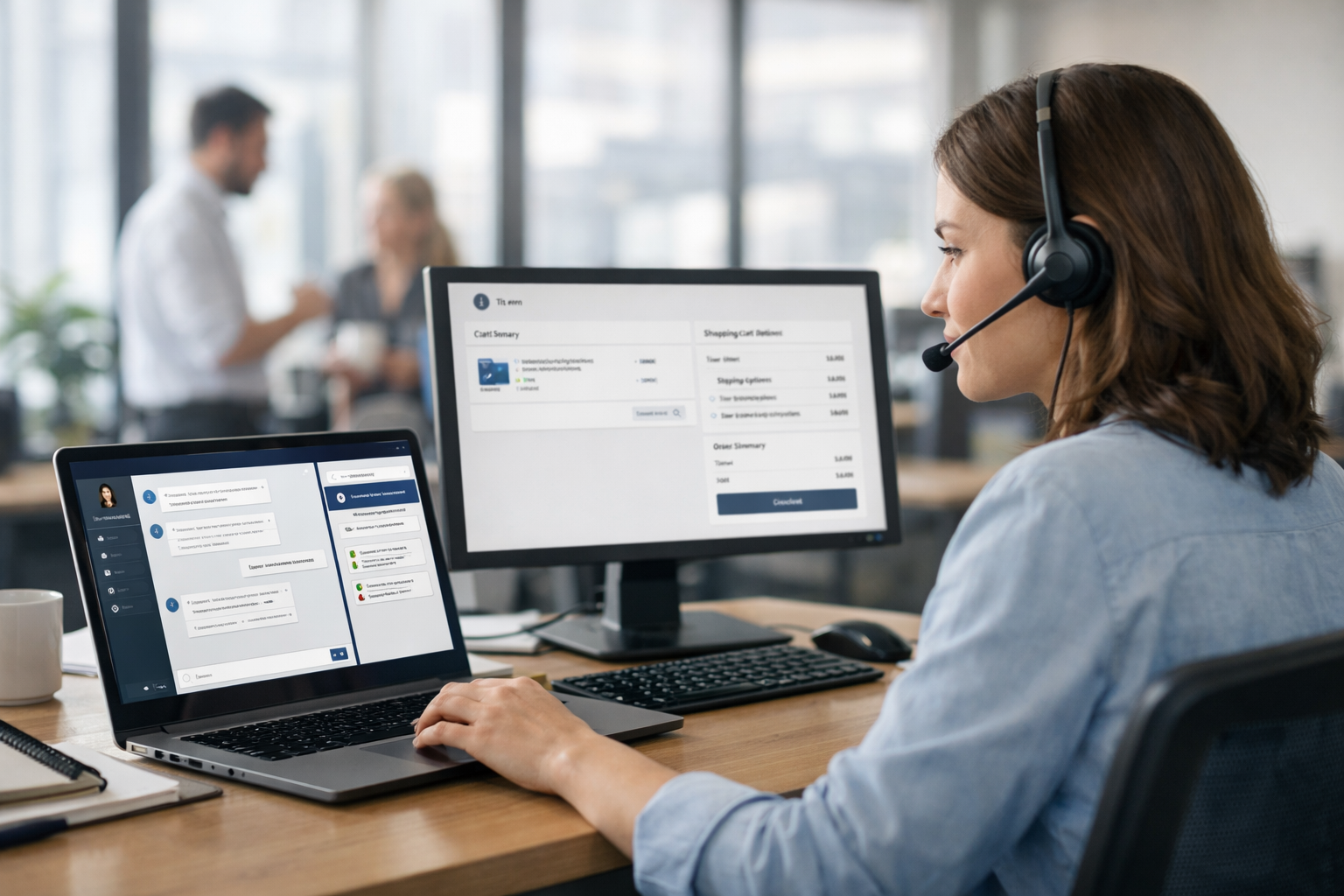
Cart abandonment usually isn’t a “no.” It’s a “not yet.” In ecommerce, shoppers leave when a shipping detail is unclear, a coupon won’t apply, sizing feels risky, or checkout friction creates doubt. Strong ecommerce customer support—especially live chat placed at the point of hesitation—reduces cart abandonment by answering questions instantly, removing uncertainty, and guiding customers through checkout in real time.
Most cart abandonment drivers fall into two categories: cost/checkout surprises and lack of confidence. The moment a shopper hesitates, their attention shifts to “risk” instead of “reward.” That’s where live chat excels: it meets the customer at the decision point, clarifies details, and keeps momentum.
Live chat reduces cart abandonment by addressing these issues before the shopper closes the tab.
Live chat isn’t just “another channel.” It’s a conversion tool when it’s fast, accurate, and available at the right moments.
Email support is too slow for checkout. Even a five-minute delay can lose the sale. Live chat gives immediate reassurance on the most common blockers: shipping costs, delivery windows, order changes, taxes, and payment issues.
Best practice: trigger chat on checkout and cart pages with message options like “Shipping & delivery questions?” or “Need help checking out?” rather than a generic “Hi.”
Shoppers abandon when return policies, warranties, and exchange processes are unclear. Live chat lets your support team summarize policies in plain language and link directly to the right page—without making customers hunt.
That clarity reduces perceived risk, which is a major predictor of checkout completion.
When a code fails or a payment method won’t load, shoppers assume the entire experience will be painful. Live chat helps them troubleshoot immediately and offers alternatives (manual discount instructions, different payment route, or a quick link to a working checkout step).
Support tip: build a short internal checklist for agents: browser cache, device check, alternate payment option, and confirmation of code rules (minimum spend, excluded items, expiration).
On product pages, shoppers can browse casually. At checkout, they need confidence. Live chat humanizes your store and signals: “If something goes wrong, help is here.” Simple messages like “I can confirm your delivery date” or “I can help if your payment isn’t going through” reduce anxiety and increase conversions.
Some issues are too nuanced for a static FAQ: international shipping constraints, bulk order requests, address edits, product substitutions, or compatibility questions. A trained agent can resolve these in one conversation and keep the customer moving forward.
Many brands add live chat and still see limited impact because the experience isn’t built for checkout-speed decisions. Here’s what consistently performs:
In ecommerce, speed is conversion. Aim for an initial reply within seconds, not minutes. If you can’t staff 24/7, a well-trained AI layer can handle the first response, collect details, and escalate to a human when needed.
Generic chatbots frustrate shoppers. The best results come from support that’s trained on your actual product pages, shipping rules, return policies, and payment options—so answers are consistent with what’s on your site.
Proactive live chat reduces cart abandonment when it appears at the right time, for the right users:
Avoid: interrupting new visitors too early. Use intent-based triggers rather than immediate popups.
When a customer asks something complex, escalation should be immediate—and the human agent should see the conversation context. The worst experience is repeating the same details twice. The best experience feels like one continuous conversation.
Cart abandonment happens around the clock. A pure human-only model struggles to maintain 24/7 coverage affordably, while pure AI can fail on edge cases. A hybrid model pairs the strengths of both:
Biz AI Last offers a single embeddable gadget that supports live text chat, voice, and video—powered by dedicated AI trained on your website content and backed by real agents 24/7. Learn more about our AI and human support services.
Use this checklist to make live chat directly impact checkout completion:
To connect live chat with revenue, measure it like a conversion tool:
If you’re running paid traffic, also evaluate ROAS impact: recovering even a small percentage of carts often pays for support many times over.
Abandonment doesn’t follow business hours. International customers, late-night mobile shoppers, and weekend traffic all create high-intent moments when your team might be offline. 24/7 live chat reduces cart abandonment by ensuring shoppers never hit a dead end—especially during peak campaigns, launches, and holiday season.
Biz AI Last provides 24/7 coverage with dedicated AI trained on your site and real human agents available for text, audio, and video—starting at $300/month. You can view our pricing to see what fits your store.
If you want to reduce cart abandonment, don’t just “add chat.” Build a support experience that answers fast, solves real problems, and escalates smoothly from AI to human—right at checkout.
To see how a single embeddable chat gadget can provide AI + human support across text, voice, and video, book a free demo and we’ll walk you through a setup tailored to your ecommerce store.
Join businesses using Biz AI Last to capture more leads and deliver exceptional support around the clock.
See How Biz AI Last Works