Loading
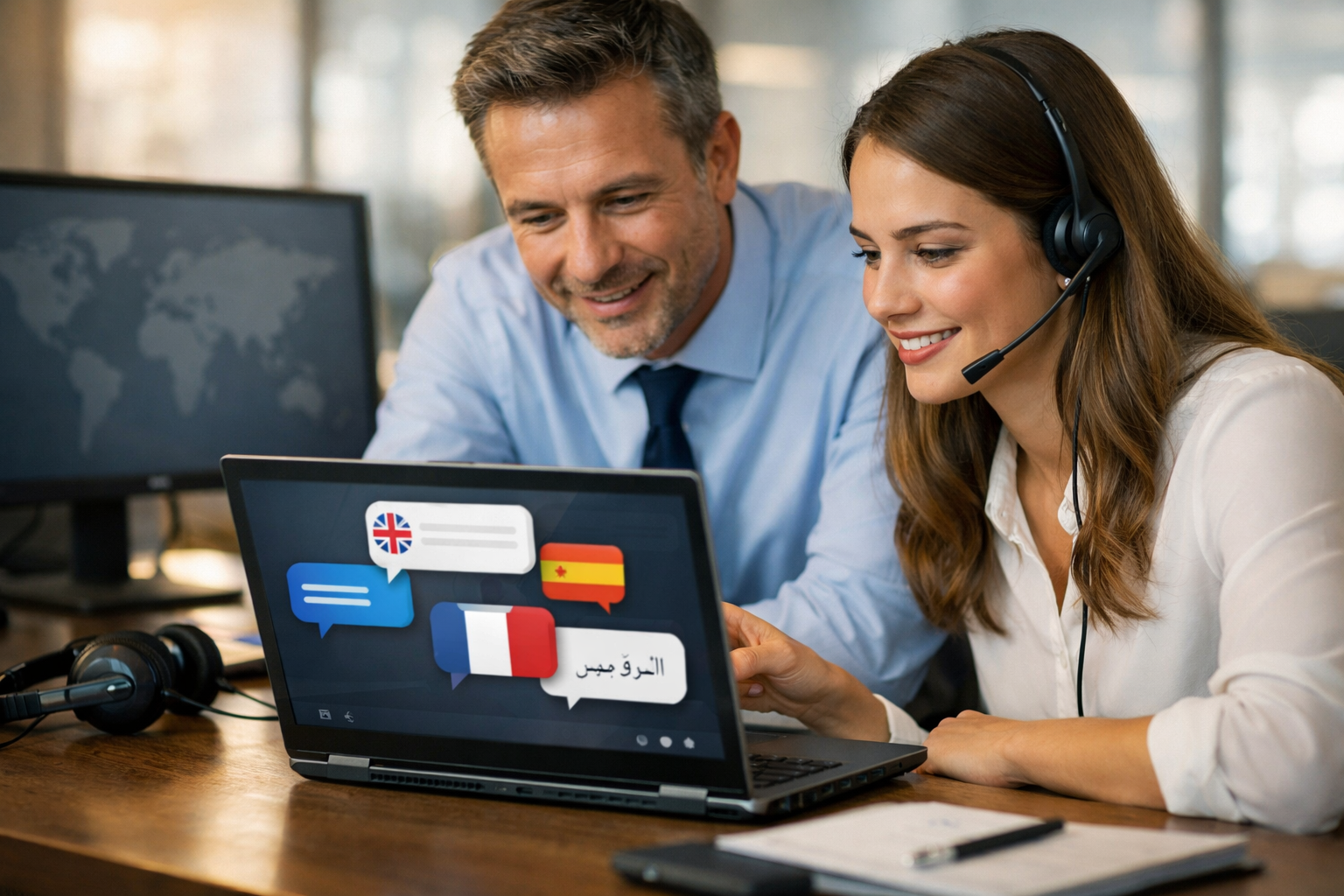
Expanding into new regions is exciting—until language barriers start costing you customers. The right multilingual AI chatbot can greet visitors in their preferred language, answer questions instantly, and route complex issues to a human agent—so your global customers feel supported at every hour, in every market.
International traffic is easy to buy and hard to convert. If a visitor lands on your website and can’t quickly get answers in their language, they often leave—especially on mobile, where patience is shorter and comparison shopping is one tap away.
Multilingual AI chatbots help global businesses close that gap by delivering instant, consistent assistance across languages. For companies serving multiple regions, this isn’t just a “nice-to-have” feature—it’s a core part of customer experience (CX), sales, and retention.
Global customers don’t wait for your office hours. A multilingual chatbot can handle first-response support at any time—nights, weekends, holidays—while your human team focuses on escalations and high-value conversations.
Biz AI Last combines AI trained on your website with live human agents available for text, audio, and video chat inside a single embeddable gadget. That means your business can provide “always on” support without hiring separate teams for each region. Learn more about our AI and human support services.
Many prospects abandon because they can’t clarify key questions fast enough—pricing, shipping, availability, onboarding steps, compatibility, or compliance. Multilingual chat reduces that friction at the exact moment a visitor is deciding whether to buy or inquire.
When the conversation happens in the visitor’s preferred language, you reduce confusion and increase confidence—two of the biggest drivers of conversion.
Hiring native speakers for every language is expensive, and relying entirely on machine translation can create misunderstandings. A well-implemented multilingual chatbot lowers costs by handling repetitive questions at scale, while still providing a path to human help for complex issues.
With Biz AI Last, the AI is trained on your own website content, so it can answer accurately based on what you actually publish—policies, product pages, FAQs, and documentation—while human agents step in when nuance, negotiation, or empathy matters most.
Speed is a CX feature. Multilingual AI chatbots typically respond in seconds, which can dramatically reduce perceived wait time and help prevent escalations caused by delays.
For global businesses, faster first-response times translate into:
When multiple teams answer in different languages, answers can drift—especially around refunds, warranties, delivery expectations, or regulated topics. Multilingual chatbots can be guided by your approved content and playbooks, keeping responses consistent across markets.
This is especially valuable if you operate in industries where policy accuracy matters (ecommerce, SaaS, financial services, healthcare-adjacent services). Consistency reduces chargebacks, disputes, and compliance risk.
Many global visitors are “high intent” but hesitant to fill out forms—particularly if the form is in a different language. A multilingual chatbot can qualify leads conversationally, collect contact details, and pass context to your sales pipeline.
Because Biz AI Last includes live agents, your highest-value leads can speak to a real person immediately—via text, voice, or video—without leaving your site.
Chat transcripts are customer research. Multilingual conversations reveal localized objections, feature requests, shipping concerns, and competitor comparisons. When you analyze this data by language or region, you can improve:
For global businesses, “AI-only” support often breaks down in the same places: edge cases, emotional situations, refunds/complaints, B2B buying committees, or complex technical troubleshooting. That’s where hybrid support outperforms.
A hybrid model offers:
Biz AI Last delivers exactly that blend through a single website gadget that supports live text, voice, and video chat—so you can serve different customer preferences across cultures and regions.
Not all “multilingual” chatbots deliver real multilingual customer experience. Use this checklist to evaluate options:
Direct translation can misinterpret idioms, product terminology, and cultural expectations. The fix: align the chatbot to your localized pages and approved phrasing, and escalate to humans when the conversation becomes sensitive or high-stakes.
Global offers and policies change frequently. A multilingual chatbot should stay aligned with your current website content—especially for pricing, shipping regions, returns, and availability.
When a bot tries to handle everything, user trust drops. Define escalation triggers (refund requests, complaints, complex setup, enterprise procurement) and make the “talk to a human” option easy.
Biz AI Last is built for companies that want multilingual coverage without sacrificing customer experience. You get:
If you’re comparing options, you can view our pricing and see what fits your traffic and support goals.
They reduce workload by handling repetitive questions and providing instant first responses, but humans still matter for complex issues, exceptions, and high-value sales conversations. A hybrid model is often the best approach for global businesses.
Start with the languages that represent the highest traffic, revenue potential, or support volume. Many companies begin with 2–5 key languages, then expand based on conversation data and conversion rates.
Yes. Chat can qualify visitors, collect contact details, and route inquiries to the right team—especially helpful when prospects are more comfortable sharing needs conversationally than completing forms.
Multilingual AI chatbot benefits for global businesses are clear: better conversions, faster support, lower costs, and happier customers across regions. The key is deploying a solution that’s accurate, brand-safe, and backed by real humans when it counts.
See how Biz AI Last can fit your website and markets—book a free demo to experience the AI + human support gadget in action.
Join businesses using Biz AI Last to capture more leads and deliver exceptional support around the clock.
See How Biz AI Last Works